
Industrial immersion heaters are electric heating devices designed to heat liquids directly inside tanks, vessels, or piping systems. They are widely used in manufacturing processes where precise and efficient liquid heating is required.
This guide explains how immersion heaters work and how to select the right heater for your application.
An immersion heater is an electric heating element designed to be inserted directly into a liquid. The heater converts electrical energy into heat, which is transferred directly to the surrounding fluid.
Immersion heaters are commonly installed in:
Because the heating element is in direct contact with the liquid, immersion heaters offer high efficiency and fast heat transfer compared to indirect heating methods such as steam jackets or external heat exchangers.
Industrial immersion heaters generate heat by passing electrical current through a resistance heating element. The element is insulated and enclosed inside a metal sheath, which transfers heat directly to the surrounding liquid.
Because the heating element is immersed in the fluid, heat transfer is highly efficient and typically approaches near-100% energy transfer efficiency.
Heat output depends on several factors including:
Electric immersion heaters can be divided into several distinct designs based on size and how they are designed to be installed into the medium being heated. At Heatmax, we carry the following immersion heaters:
Flanged immersion heaters are electric heaters installed through a tank flange or pressure vessel flange. They are commonly used for high-power heating in large tanks and pressurized vessels.
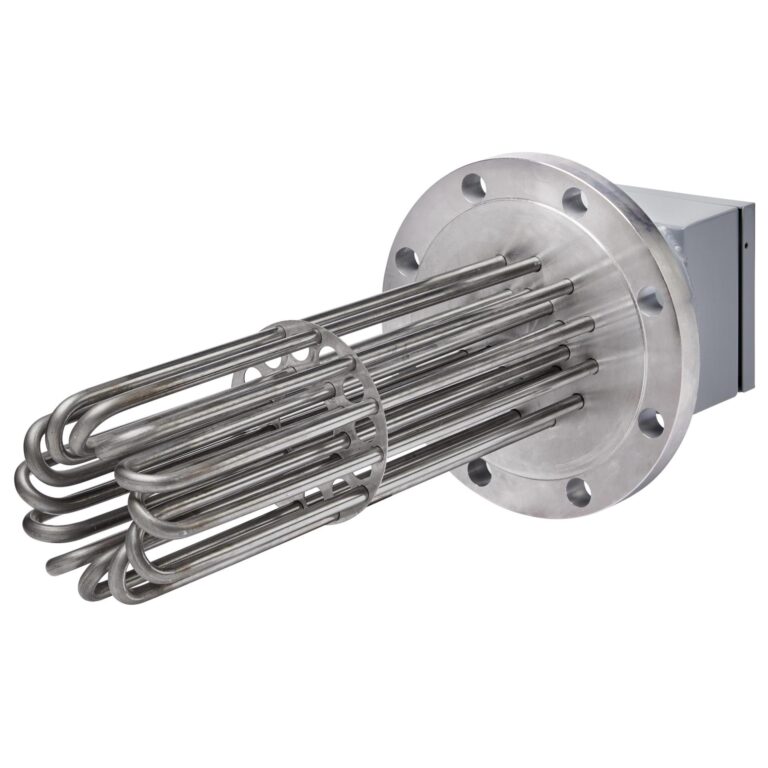
See our flanged immersion heaters product page for more information.
Screw plug heaters install directly into threaded openings in tanks or piping systems.
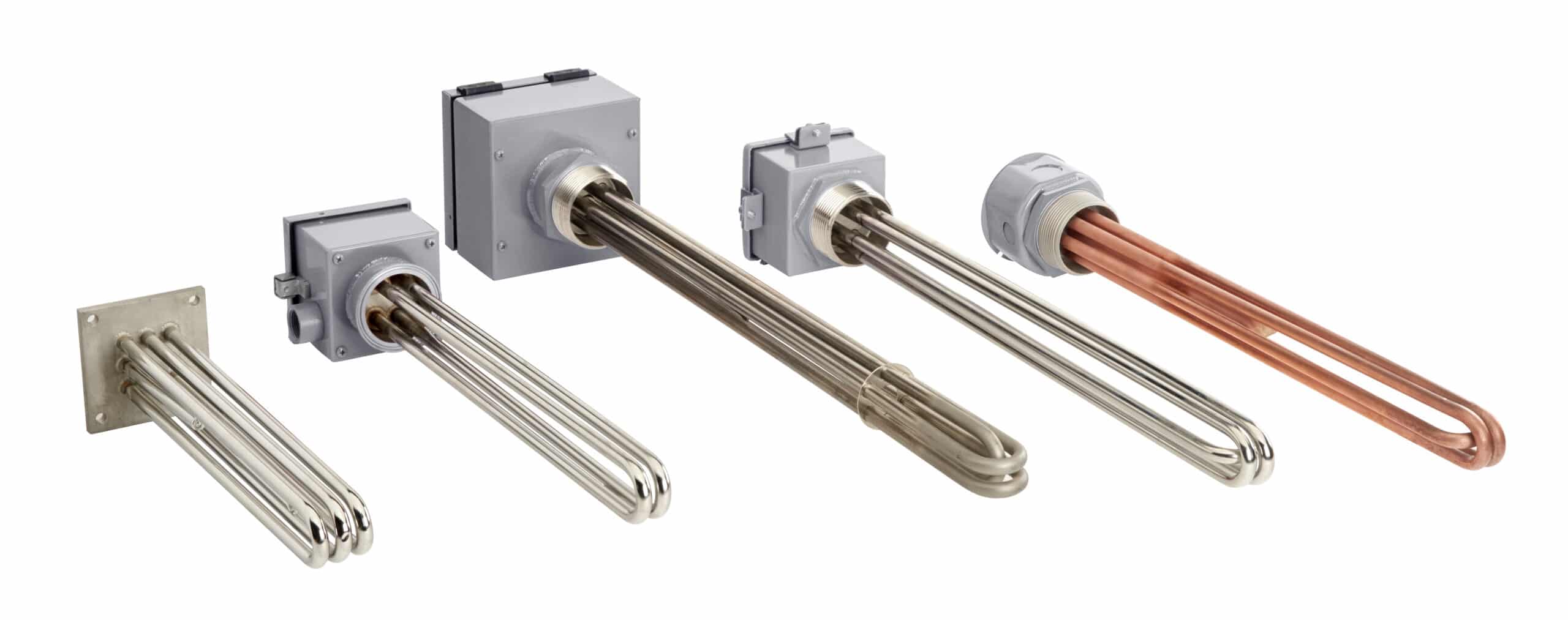
See our screwplug immersion heaters product page for more information.
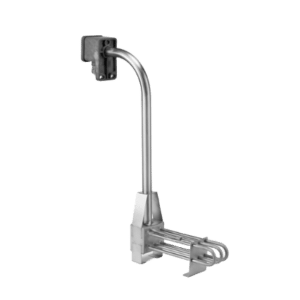
Over-the-side heaters are designed for open topped tanks and either to be mounted to the tank rim, or resting at the bottom of the tank itself. They require no permanent tank fittings or tank modifications.

Now that you know what an electric immersion heater is, what they do, how they work and the different varieties you have to choose from, it’s time to get into the specifics that will help your heater work at total efficiency and have a long lifespan. These are some of the most important elements to consider before ordering your industrial immersion heater.
The sheath material of an immersion heater must be compatible with the fluid being heated. Using the wrong material can result in corrosion, contamination of the fluid, or premature heater failure.
The table below outlines common sheath materials and the types of fluids they are typically used with.
| Sheath Material | Best For | Typical Applications | Maximum Recommended Sheath Temperature |
|---|---|---|---|
| Copper | Clean water, neutral liquids | Domestic water heaters, potable water tanks | ~350°F |
| Stainless Steel (316) | Water, mild chemicals, detergents | Process water tanks, parts washers, rinse tanks | ~1200°F |
| Incoloy (800) | Weak chemical solutions, demineralized water, higher temperature liquids | Industrial process tanks, chemical tanks, boiler systems | ~1600°F |
| Stainless Steel (304) | Oils and heat transfer fluids | Oil reservoirs, lubrication systems, thermal oil tanks | ~750°F (oil applications) |
| Titanium | Chlorides, salt water, plating solutions | Nickel plating tanks, rinse tanks, seawater heating | ~600°F |
| Hastelloy | Strong acids and aggressive chemical environments | Chemical processing tanks, acid systems | ~250°F |
| PTFE Coated | Highly corrosive acids and plating chemistries | Chrome plating tanks, acid tanks, aggressive chemical processing | ~212°F |
Watt density refers to the amount of heat produced per square inch of heater surface area.
Selecting the correct watt density is critical because excessive heat can damage fluids or cause heater failure.
| Fluid Type | Example Fluid | Sheath Material | Watt Density (W/in²) |
|---|---|---|---|
| Clean water | Potable water | Copper | 45 |
| Process water | Rinse tanks | Stainless steel | 45 |
| Deionized water | DI water | Incoloy | 45 |
| Mild chemicals | Weak acids / alkali | Stainless steel | 23 |
| Corrosive chemicals | Strong acids | Incoloy | 15 |
| Oil | Low viscosity oil | Stainless steel | 23 |
| Oil | High viscosity oil | Stainless steel | 6.5 |
Watts = (Volume × Temperature Rise × Fluid Factor) / Heat Up Time
A heater manufacturer can assist in calculating the correct wattage and watt density for a specific application. We also have a wattage calculator available here.
Industrial immersion heaters are used to heat liquids directly inside tanks, vessels, and process equipment. Because they transfer heat directly into the fluid, they are one of the most efficient methods of industrial heating.
Below are several common industrial heating applications outside of metal finishing and plating.
Many industrial machines and engineered systems incorporate immersion heaters as internal components. In these cases, heaters are integrated directly into equipment during manufacturing rather than installed later in tanks.
Immersion heaters provide compact, reliable heating that can be easily controlled with thermostats or process controllers.
40–450°F
These heaters are commonly specified by OEM equipment manufacturers designing hydraulic systems, process skids, or industrial machinery.
Immersion heaters are widely used for industrial water heating in rinse tanks, wash systems, and process water tanks. Many facilities require heated water for washing, processing, sanitation, or freeze protection.
90–180°F
Nearly every industrial facility heats water somewhere in its process, making this one of the largest immersion heater markets.
Immersion heaters are commonly used to heat oils and heat transfer fluids in tanks and circulation systems. Heating oil improves viscosity, enables pumping, and stabilizes process temperatures.
120–450°F
Many of these systems are integrated into OEM equipment such as hydraulic power units, heat transfer systems, and industrial machinery.
Immersion heaters are frequently used in chemical processing to maintain reaction temperatures or control fluid viscosity.
100–300°F
These applications are often part of engineered systems designed by OEM equipment manufacturers or chemical processing companies.
Heated cleaning solutions are widely used in industrial manufacturing to remove oils, grease, and machining residues from metal components.
120–190°F
These systems are widely used in automotive manufacturing, aerospace production, and machine shops.
Immersion heaters are sometimes used in water treatment facilities to prevent freezing or maintain stable chemical reaction conditions.
40–140°F
Water treatment heating is often used in municipal infrastructure, industrial wastewater plants, and environmental processing systems.
Outdoor tanks and storage vessels often require freeze protection to prevent liquids from freezing during cold weather. Immersion heaters provide a reliable method of maintaining minimum fluid temperatures inside tanks.
Because the heater is placed directly inside the tank, heat is delivered efficiently and can be controlled using thermostats or temperature controllers.
40–60°F (freeze protection range)
Freeze protection systems often include thermostats or control panels that activate heaters automatically when temperatures drop below a set point.
Choosing the correct immersion heater requires evaluating fluid chemistry, tank geometry, watt density, and power requirements.
Heatmax engineers can help specify the correct heater for:
Contact our team with your tank dimensions and process details for assistance selecting the correct heater.
Ask An Expert