
Municipal wastewater treatment facilities depend on reliable process heating to maintain disinfection systems, meet regulatory requirements, and avoid costly downtime. When a large electric heater fails, the disruption is immediate and significant—lost time, emergency labor, chemical handling risks, and frustrated operators. At the same time Sodium Hypochorite poses a challenge, it is corrosive to heated surfaces and can shorten the lifespan of Stainless Steel and even Incoloy Heaters. Finding a reliable Sodium Hypochlorite heater is a challenge.
That was exactly the situation facing one municipal wastewater treatment facility before they partnered with Heatmax Heaters. Their sodium hypochlorite system was experiencing frequent heater failures, leading to repeated shutdowns and replacements. The issue, however, was not workmanship or heater sizing—it was chemistry.
Sodium hypochlorite is a powerful oxidizing agent. While many alloys perform well in general chloride environments, oxidizers dramatically change the corrosion mechanism.
Stainless steel and Incoloy rely on passive films that are vulnerable in strong oxidizing environments. Once those films are compromised, oxidation progresses, leading to pitting, sheath attack, and premature heater failure.
In this application, heaters manufactured from Incoloy were suffering accelerated degradation making them a poor long-term choice for hypochlorite service.
Heatmax recommended a switch to Titanium Grade 2, a material uniquely suited to sodium hypochlorite applications.
Titanium is nearly immune to hypochlorites. Its superior performance comes from a highly stable oxide film that forms naturally on the surface. Crucially, this oxide layer regenerates almost instantly in the presence of water or oxygen if it is disturbed. This self-healing characteristic gives titanium exceptional resistance to oxidizers—something stainless steel and Incoloy simply cannot match.
In short:
Stainless steel and Incoloy suffer from it
By addressing the chemical compatibility rather than continuing to replace failing heaters, the facility eliminated the root cause of their downtime.
After converting to a titanium flanged heater solution:
Heater-related downtime was reduced by approximately 50%
Unplanned maintenance events dropped sharply
Emergency changeouts became far less frequent
Overall system reliability improved measurably
Just as important, the maintenance team regained confidence that heater replacements would be the exception—not a recurring disruption.
Heatmax is the only manufacturer in North America offering UL-certified titanium flanged heaters—a critical distinction for municipal and public infrastructure projects where compliance and safety approvals are mandatory.
Our Max-Ti™ Series Titanium Heaters are specifically engineered for aggressive oxidizing environments like sodium hypochlorite systems commonly found in wastewater treatment facilities making it an ideal sodium hypochlorite heater.
If your sodium hypochlorite system is going through stainless steel or Incoloy heaters faster than expected, the issue may be material selection. We manufacture drop-in replacement heaters that match your existing Stainless Steel or Incoloy Sodium Hypochorite Heater with Titanium equivalent. All you need to do is connect power.
A brief application review with a Heatmax expert can determine whether a titanium solution can:
Extend heater life
Reduce downtime and labor costs
Lower total cost of ownership
Eliminate recurring maintenance headaches
Speak with one of our experts today to see if our Max-Ti Series Titanium Heaters can save you time and money in your sodium hypochlorite application.
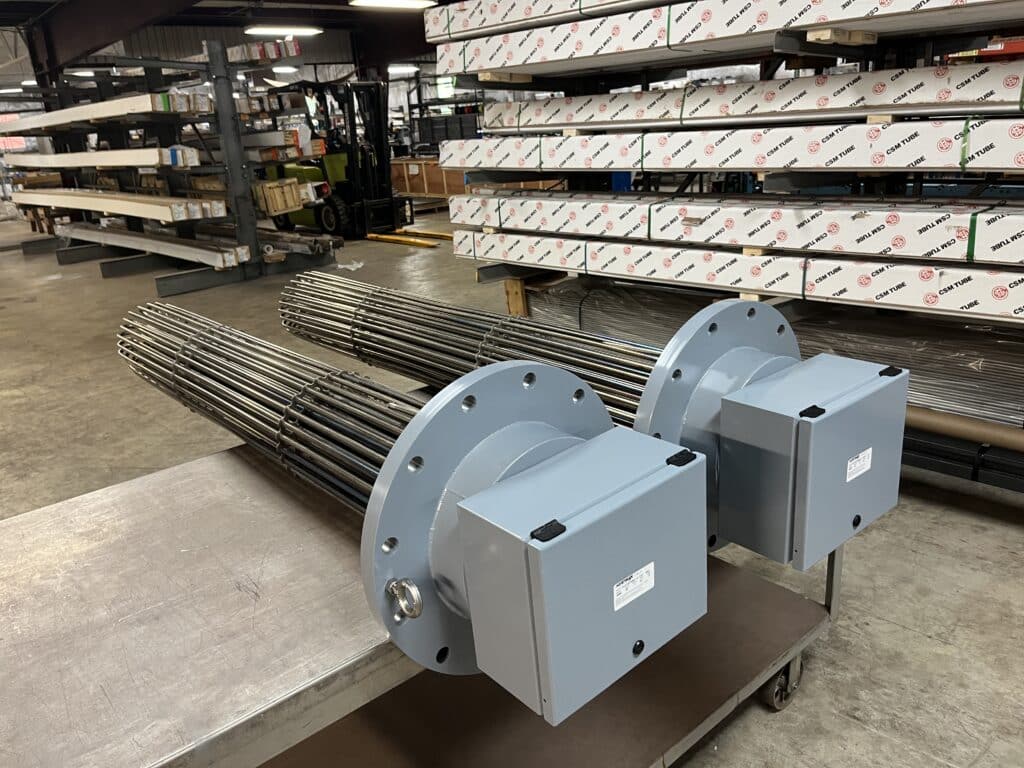
Two Titanium 12″ ANSI Flanged Sodium Hypochlorite Heaters Ready to Ship to a Municipal Wastewater Treatment Facility.
